
Skillentras · Skills That Transform
Instructional Design · Facilitation
The Art of Designing Effective Learning Sessions
A Practical Programme for Trainers and Facilitators
About the Programme
Many trainers know their content well, yet their sessions do not always produce lasting learning. The difference is rarely knowledge. It is design.
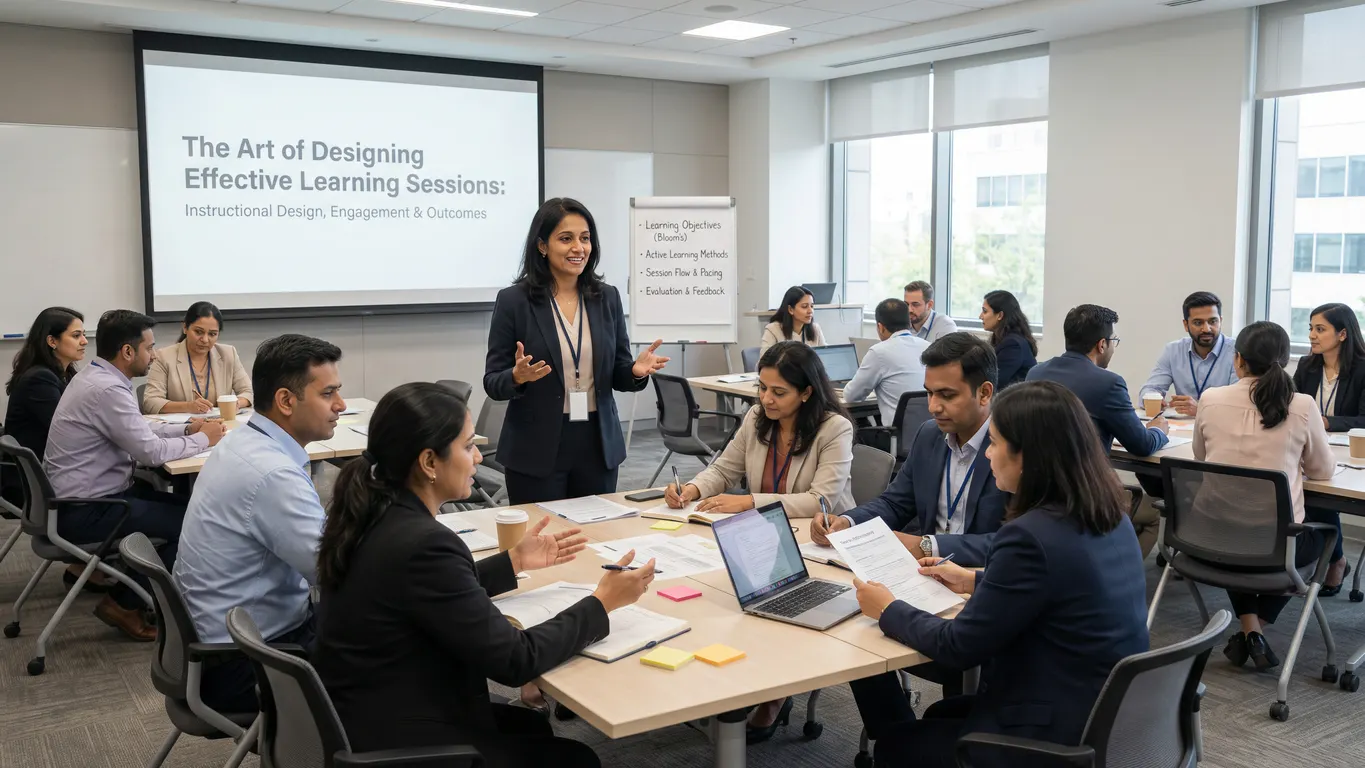
This one-day programme gives trainers and facilitators a clear, repeatable structure for planning sessions that engage participants, build understanding and lead to real application. You will experience the framework first, then learn it, then use it to redesign a session of your own.
The programme is built on the five-phase instructional model (Engage, Explore, Explain, Elaborate and Evaluate), developed by Rodger Bybee and colleagues at the Biological Sciences Curriculum Study (BSCS) and grounded in constructivist and experiential learning theory. Adapted here for adult and corporate learners, it moves the trainer from telling to facilitating.
Instructor
Facilitator: Zulfiqar Ali Qureshi
Zulfiqar Ali Qureshi is an independent corporate trainer, executive educator, management consultant and author with over 30 years of professional experience across the pharmaceutical, healthcare and corporate sectors. He is the founder of Skillentras, the originator of the Certified Training Professional certification in Pakistan, Visiting Faculty at the Pakistan Institute of Management (PIM), and a former Head of Faculty at ELJ Australia.
Course Objectives
- Explain the five phases of the instructional model and the trainer’s role in each
- Distinguish sessions that tell, sessions that only keep people busy and sessions that build understanding
- Open a session with a hook that creates genuine curiosity
- Design discovery activities that let participants find the idea before it is named
- Explain concepts through simple everyday analogies and examples
- Build application tasks and checks for understanding into every session
- Redesign a segment of your own session using the five-phase structure
- Adapt a session design for online and hybrid delivery
Who Should Attend
- Corporate trainers and facilitators
- Learning & Development and HR professionals who design or deliver training
- Managers and subject matter experts who train their teams
- Educators and academics moving into corporate training
- Consultants and coaches who deliver workshops
- Aspiring trainers building a professional foundation
Course Plan
| Session / Day | Module | Focus |
|---|---|---|
| 1 | How Learning Really Happens | Why good sessions are forgotten, how adults learn from experience, and learning through variation and contrast |
| 2 | Strong and Weak Session Designs | Analysing three session designs and building your own criteria for effective design |
| 3 | The Five-Phase Framework | Engage, Explore, Explain, Elaborate and Evaluate: purpose, trainer’s role and participants’ role |
| 4 | The Designer’s Toolkit | Hooks, discovery activities, analogies, application tasks and checks for understanding |
| 5 | Build Your Own Session | Redesigning a 30 to 45 minute segment of your own session, including online adaptation |
| 6 | Teach, Feedback & Action Plan | Micro-teaching, structured peer feedback and a personal action plan |
Note: The programme runs over one day (6 learning hours), and each module follows the same experience-first approach it teaches.
Teaching & Learning Methodology
- Experience-first sessions: participants try, discuss and discover before they receive the framework
- Live demonstrations and short experiential exercises
- Group analysis of real session designs
- A hands-on design workshop using your own content
- Micro-teaching with structured peer feedback
- A reusable five-phase planning template and design rubric
Learning Outcomes
Participants will leave with:
- Design framework: A clear five-phase structure for planning any training session.
- Engagement skills: Hooks and discovery activities that create curiosity before content.
- Explanation skills: Analogies and examples that make complex ideas simple.
- Application and checking: Tasks that transfer learning and show whether it has landed.
- A finished design: A completed, feedback-tested design for one of your own sessions.
Prerequisites
No prior instructional design qualification is required. Participants are encouraged to bring one real session they will deliver soon, so they can redesign it during the programme.
Key References
- Bybee, R. W., Taylor, J. A., Gardner, A., et al. (2006). The BSCS 5E Instructional Model: Origins, Effectiveness, and Applications. BSCS.
- Kolb, D. A. (1984). Experiential Learning: Experience as the Source of Learning and Development. Prentice Hall.
- Knowles, M. S. (1984). The Adult Learner: A Neglected Species. Gulf Publishing.
- Marton, F., & Booth, S. (1997). Learning and Awareness. Lawrence Erlbaum.
- Eisenkraft, A. (2003). Expanding the 5E model. The Science Teacher, 70(6).